 |
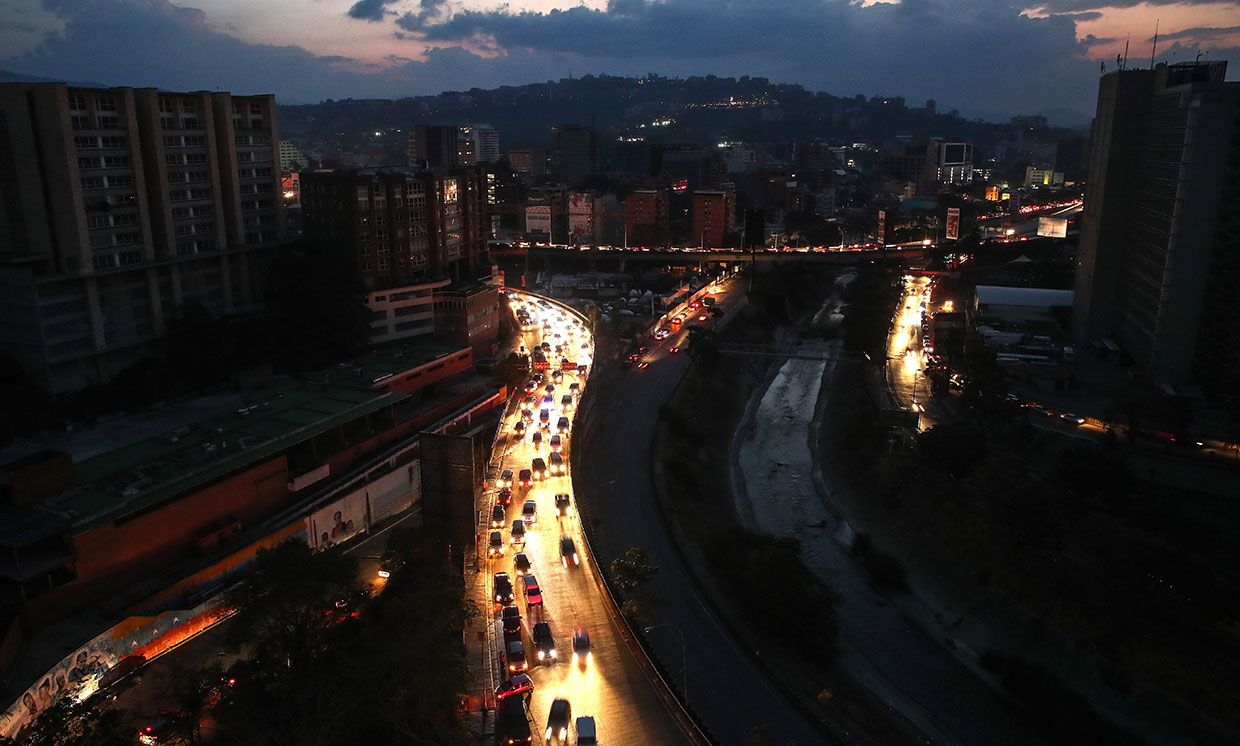
| Venezuela's capital Caracas in the recent blackout |
There has been a lot of claims circulating lately about US sanctions on Venezuela. Some left-wing groups and individuals claim these sanctions are responsible for the present economic crisis in Venezuela, while others say they are not. Fortunately, this is not a case of 'he said', 'she said', as the facts are easily available to anyone who wants to know. Let's have a look.
In one of my previous jobs, I was responsible for a company's export controls. This meant figuring out whether it was legal to export a certain type of product to any given country. There are certain classes of products for which this process is difficult and opaque - like anything military and nuclear - where you have to ask the government for permission to export and this permission can be denied on political grounds. But for the overwhelming number of products, the process is actually quite easy and transparent - and the whole international trade system depends on it being that way.
This is because companies need to know what they can and cannot export, and they cannot wait for government employees to get back to them on such questions. Unless of course you sell anything military, nuclear, rockets etc., and such products have exorbitant prices where dealing with all the government red tape is included.
This means of course that all details on economic sanctions are available online, for everyone to see. And what you see is what you get. You cannot really have 'hidden' sanctions since people can go to jail for violating them and the US government can be sued if they prevent a company to profit from its exports and imports without publicly available laws and regulations to back them up.
Since we are interested in blame for the current crisis, I will only look at sanctions from 1998 when Chavez took power and until the end of 2018. The current sanction status is a bit unclear to me, and will probably change between the time I write this and by the time you read it, so we will skip that. In any case, the recent round of sanctions after 2018 cannot be held responsible for the economic crisis that has strangled Venezuela for several years already.
So first, let's establish the timeline of events. When did the present economic crisis begin (1)?

The economic turmoil in Venezuela has been ongoing for a while, with an acute crisis in 2007-2008 (2), but the present crisis can be traced back to end of 2012 or beginning 2013 (3). By early 2014 its GDP started to decline year over year.
I would love to add some more data and graphs here to show Venezuela's economic decline, but reliable statistics on Venezuela are hard to come by. During 2015, the economic crisis had become hard to not notice in the news, as the exodus of people fleeing the country began to rival that of war-torn Syria.
Ok, back to where to place the blame. Let's look at the full list of sanctions imposed by the US.
First, there is a list of sanctions that are widely acknowledged to have no bearing on the present situation:
- Since 2006, the US has prohibited sale and transfer of military equipment to Venezuela (4).
- In 2008, two individuals and two travel agencies were sanctioned for their relations with Hezbollah (4).
- Since 2008, a number of named Venezuelan individuals have been sanctioned due to their alleged involvement in drug trafficking and money laundering networks (4).
- In 2011, Venezuelan state oil company PDVSA was barred from direct contracts with the US government and certain US government financing. However, since it did not prevent its US subsidiary, Citgo, from the doing these things, this had practically zero effect, and was widely seen at the time as merely a slap on the wrist or a warning shot (5).
From 1998 and until late 2014 there were no economic sanctions worthy of note. Even people who blame the US for all Venezuela's problem generally do not point to these specific sanctions.
In December 2014, US Congress passed the "Venezuela Defense of Human Rights and Civil Society Act of 2014" (6), that prepared the ground for further sanctions. These sanctions were implemented by a US presidential Executive Order in March 2015 called "Blocking Property and Suspending Entry of Certain Persons Contributing to the Situation in Venezuela" (7). You can read the full text of both the Act and the Executive Order online.
These sanctions target a list of individuals later named who are involved in what it cites as human rights abuses, corruption or authoritarian acts. The sanctions involve denial of entry into the US and restricts commercial activity with these individuals, effectively freezing property they might have in the US. This does not prevent general imports or exports. In fact, the Act specifically took this option off the table:
EXCEPTION RELATING TO IMPORTATION OF GOODS. — The requirement to block and prohibit all transactions in all property and interests in property under paragraph (1)(A) shall not include the authority to impose sanctions on the importation of goodsThe next round sanctions came two and a half years later in August 2017 in the form of another Executive Order called "Imposing Additional Sanctions with Respect to the Situation in Venezuela". It forbids any US citizen or organization from issuing loans or buying bonds from the Venezuelan government and PDVSA (8). However, Venezuelan government and PDVSA debt was already junk rated by this time, so few were interested in buying it anyway. It did not prevent any other countries or citizen of other countries from buying these junk bonds.
Then, in 2018, followed a series of three Executive Orders to impose further sanctions.
In March 2018, an Executive Order called "Taking Additional Steps to Address the Situation in Venezuela" specifically targets the "Petro" cryptocurrency, bans US citizens from using it, and makes it clear that it cannot be legally used to circumvent sanctions (9). Since the "Petro" managed to flop spectacularly on its own, this sanction likely had zero effect.
In May 2018, an Executive Order called "Prohibiting Certain Additional Transactions with Respect to Venezuela" imposes further restrictions on buying government bonds, and, curiously, bans US citizens and companies from purchasing Venezuelan government properties put up for sale (10). (Curiously, because this would help prevent the kind of privatization and fire-sale of government properties that took place in Eastern Europe and Russia after the fall of the "Iron Curtain".)
In November 2018, an Executive Order called "Blocking Property of Additional Persons Contributing to the Situation in Venezuela", targeted individuals and companies operating in Venezuela's gold sector and companies owned by PDVSA (11). It is extensive and open-ended, and would no doubt have had a chilling effect on exports. It does not affect Venezuelan imports.
And that's it. As we have seen above, there have been no general sanctions on imports, or no general sanctions on any exports until November 2018, when the entire gold sector was hit. The EU also did not initiate any sanctions until November 2018, when it restricted only a few categories of exports to Venezuela, such as weapons (12).
The conclusion is clear: There are no general sanctions on imports or exports, but a series of steadily stricter sanctions on individuals in the Venezuelan government and companies they control. Also, the economic crisis was not caused by the sanctions - this is impossible as the crisis predates the sanctions by several years.
Don't fall for Venezuelan government propaganda.
--
Postscript (March 18th): Francisco Rodríguez writes wrote an insightful article at https://venezuelablog.org/crude-realities-understanding-venezuelas-economic-collapse/ about the Venezuelan economic crisis, which is definitely worth reading in full, where also says the follow on the sanctions:
It is striking that the second change in trend in Venezuela’s production numbers occurs at the time at which the United States decided to impose financial sanctions on Venezuela. Executive Order 13.808, issued on August 25 of 2017, barred U.S. persons from providing new financing to the Venezuelan government or PDVSA. Although the order carved out allowances for commercial credit of less than 90 days, it stopped the country from issuing new debt or selling previously issued debt currently in its possession.and
... claiming that Maduro’s economic policies have caused a deterioration of living standards in Venezuela is not at odds with accepting the possibility that economic sanctions may have made things even worse. ... While the evidence presented in this piece should not be taken as decisive proof of such a link, it is suggestive enough to indicate the need for extreme caution in the design of international policy initiatives that may further worsen the lot of VenezuelansAnd I fully agree with that.
Sources:
- https://www.economist.com/graphic-detail/2016/02/18/venezuela-a-nation-in-a-state
- https://www.theguardian.com/world/2007/nov/14/venezuela.international
- https://www.theguardian.com/global-development/poverty-matters/2013/sep/26/venezuela-food-shortages-rich-country-cia
- https://fas.org/sgp/crs/row/IF10715.pdf
- https://www.bbc.com/news/world-latin-america-13542239
- https://www.congress.gov/bill/113th-congress/senate-bill/2142/text
- https://www.treasury.gov/resource-center/sanctions/Programs/Documents/13692.pdf
- https://www.treasury.gov/resource-center/sanctions/Programs/Documents/13808.pdf
- https://www.treasury.gov/resource-center/sanctions/Programs/Documents/13827.pdf
- https://www.treasury.gov/resource-center/sanctions/Programs/Documents/venezuela_eo_13835.pdf
- https://www.treasury.gov/resource-center/sanctions/Programs/Documents/venezuela_eo_13850.pdf
- https://eur-lex.europa.eu/legal-content/EN/TXT/?qid=1510656303187&uri=CELEX:32017D2074Other sources of interest:


 I remember one song by Aqua from six years ago, and it is "Barbie Girl", where they sang about what it was like to be a plastic toy.


